National Institute of Health
menu
-
About NIH
About NIH
The National Institute of Health is a government agency
leading public health and medical research in South Korea
-
Research Activities
About NIH
Browse the latest research papers,
patents, and technological achievements
- Support Activities
-
Announcement
About NIH
Recent news from the National Institute of Health




National Biobank of korea(NBK)
Registered Content
1. Overview
The National Biobank of Korea (NBK) is responsible for overseeing the Korea Biobank Project (KBP).* NBK systematically collects, manages, and provides population-based human bioresources** obtained through major survey projects conducted by the Korea Disease Control & Prevention Agency (KDCA) and the National Institute of Health (NIH), including the Korean Genome & Epidemiology Study, the Korea National Health & Nutrition Examination Survey, and a variety of infectious-disease studies.
- *A biobank project launched in 2008 by the KDCA-affiliated National Institute of Health. Its aim is to secure and manage human bioresources at the national level for use in future biomedical research and industry. By providing access to these bioresources, the project supports the advancement of health research and related industries, ultimately contributing to a healthier future for the nation.
- **Human bioresources refer to human-derived materials, including blood, tissue, cells, and bodily fluids, as well as genetic data analyzed from these materials and associated clinical and epidemiological information that includes health data, medical history, and family history.
To promote the systematic collection and management of disease-based human bioresources, the NIH has established the Korea Biobank Network (KBN)* in collaboration with human biobanks located within private university hospitals, providing financial and operational support for their activities.
- *The KBN consists of NIH-supported private biobanks and related institutions. The network brings together 30 specialized human biobanks, four innovative biobanking consortia, and two KBN partner hospitals, working systematically to secure and manage disease-based human bioresources.
2. Description
maintains samples from 466,303 individuals (as of December 31, 2024)
| Legal Status | |
|---|---|
| Operating Body | |
| Governing Committees |
Key Functions
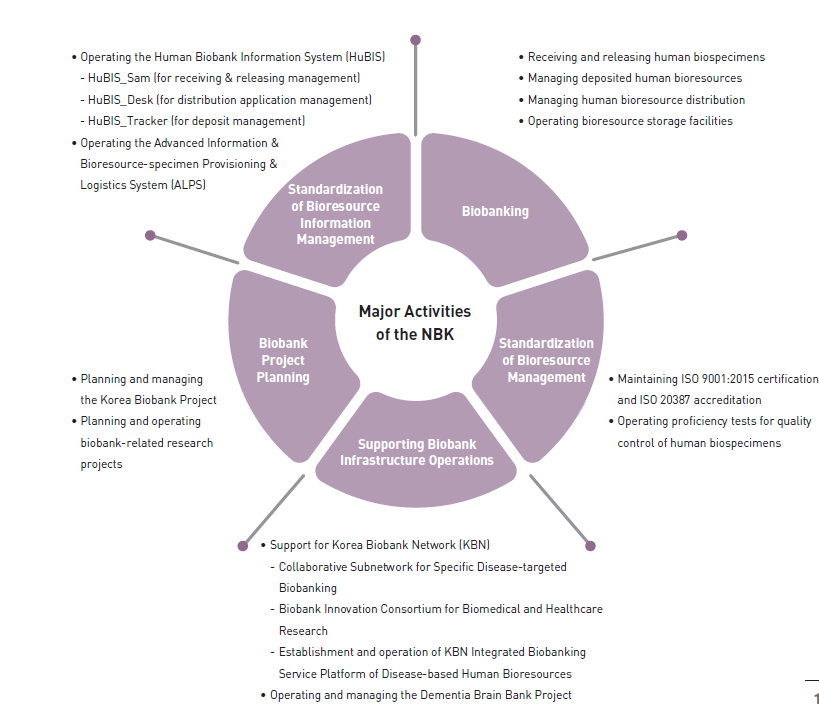
3. Key Achievements
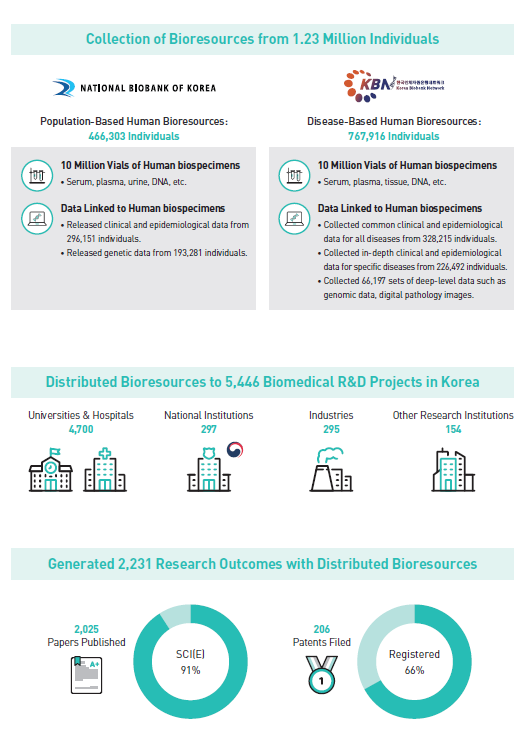
NBK
The National Biobank of KoreaFor more information, visit the National Bank of Korea
- website:
- https://biobank.nih.go.kr/eng/